Line 6 Workbench Hd Software System Requirements Mac
- Line 6 Workbench Hd Software System Requirements Mac Os
- Workbench Hd Software
- Line 6 Workbench Hd
- Line 6 Workbench Hd Download
The Line 6 Software Downloads page Or, if you already have the Line 6 Monkey application installed on your computer, you can use it to grab POD HD Edit, as well as any available product updates (please see “Updating with Line 6 Monkey™” on page 4.1). System Requirements. Workbench Mac Informer. Featured Workbench free downloads and reviews. CLC Combined Workbench creates a software. Workbench HD. Free 14 Line 6, Inc. Workbench HD is the companion editor for the James Tyler Variax guitars with Variax HD firmware. Workbench HD is the companion.instruments or revered classics. Line 6 Software & Plug-ins. Get More at Sweetwater. 55-point Guitar Inspection. Line 6 RJ45 to USB I/O for Variax Workbench RJ45-to-USB Interface for Workbench Custom Guitar Modeling Software For Variax Guitars - Mac/PC $99.99. Or $3/month § for 48 months. Workbench HD is the companion editor for the James Tyler Variax guitars with Variax HD firmware. With this app you can mix and match body styles, pickups, components and more to create unique instruments or revered classics. Workbench HD is compatible with all James Tyler Variax guitars that have been updated with the Variax HD firmware V2.0 or greater.
The revolutionary Variax modelling guitar is already a uniquely versatile instrument, but now Line 6 have added an extra dimension with the ability to customise almost every aspect of its operation.
By now most guitar players will be aware of the Line 6 Variax guitar even if they've never played one, but I was still surprised to find recently that this somewhat radical instrument now accounts for around 2 percent of the total global electric guitar market. Now that that range includes some more upmarket guitars and a choice of tremolo or hardtail designs, a greater number of serious players are starting to use them on the road and in the studio, where the total lack of electromagnetic buzz and the ability to switch between guitar types is a huge attraction. I'm not about to get into an argument as to whether the digital modelling wizardry inside Variax is a satisfactory replacement for a shedful of conventional guitars, but for myself, I think they have enough to offer that it's worth owning one, and most of the electric guitar models get very close to what they purport to emulate. The acoustic sound is certainly fine for live use in a rock band where feedback might otherwise be a problem, and then there are those endearing 'trick' sounds such as the sitar, the 12-string, the resonator guitars and the banjo. What may be less well known is that Line 6 also produce some very easy to use Workbench editing software for the Variaxes, which allows you to design 'your own' guitars and save your own custom tunings.
On The Bench
To use the Variax Workbench software, you need a Variax Electric 300, 500, 600 or 700-series guitar and a suitable Mac or PC. A version is also available for the Variax acoustic models, though this of course does not include pickup modelling. Windows users need XP or Windows 2000 with at least a 500MHz Pentium III processor, one available USB port, and 256MB or more RAM. Macintosh users need to have OS 10.3.8 or higher and a 400MHz or faster G4 or G5. Those with Vetta II amplifiers or Pod XT Live processors can use these to connect to the computer via USB, in which case the Variax Workbench software can be downloaded free of charge from the Line 6 web site. If you don't have one of these devices, you'll also need to buy a Variax Workbench pack, which includes a small buss-powered USB interface that connects to the socket under the rubber cover on your guitar, via the included RJ45 cable.
Nov 22, 2019 I tried, Line6 Monkey installs, but won't run because its built for 32 bit and my Mac OS is the latest, which only supports 64bit apps. I installed the driver manually, which 'works', however the Line 6 X3 Live is not found in Mac OSX Catalina, and I can't record any audio through Ableton, it also doesn't come up as a device. . PODxt, PODxt Pro, and PODxt Live with firmware version 3.0 or greater. The above Line 6 devices all require driver version 3.0 (or later) for use with GearBox 2. System requirements call for Mac OS X v10.3 or higher and a G4/400MHz or faster, as well as a Variax 300, 500 or 700 guitar and an amplifier available to plug the Variax output into for monitoring.
One neat aspect of Variax Workbench is that you can hear changes to your custom guitar almost as soon as you've made them, as long as you have the conventional guitar output plugged into an amplifier (usually via the XPS footswitch) — no audio from the guitar is sent to the computer, only editing data. Note that your Variax still needs to be powered when you're editing — the USB interface doesn't power the Variax. Though the memory space in a Variax is limited to 60 presets, you can create as many guitars as you like using Workbench 's Librarian and then store them on your computer's hard drive. You transfer to the guitar only the ones you need. Your 'new guitars' may be transferred to any of the Variax switch positions, though my guess is that most users will choose the 10 Custom 1 and Custom 2 presets at either end of the selector knob range so that they leave all the main guitar models intact. The way this works, for those who aren't familiar with the Variax, is that the selector knob acts much a like a bank selector, while the five-way switch on the guitar body selects a patch from within that bank. With the factory guitars, this switch often acts as a pickup selector, but it doesn't have to — each switch position can call up an entirely different guitar if you want it to.
Editing even extends to the ability to vary the capacitance of the Variax's virtual components.Once Variax Workbench has been installed, which is very straightforward, pressing the New button gets you into the workshop part of the program which is divided into three tabbed screens: Bodies, Pickups and Controls. There's also a section at the bottom of the screen that deals with creating alternate tunings, where you drag little red blobs up or down the strings from the zero position to provide up to one octave of pitch change per string in either direction. This can be used to create any custom open tuning or virtual capo, though if you move too many semitones from the original pitch, some processing artifacts tend to be audible. You can even turn off the low string and then set up a five-string open 'G' tuning for those Keith Richard licks. There are also controls for adjusting the individual string levels, and where a 12-string model is selected, you can change the degree of detuning in the string pairs.
The Bodies screen, as you might expect, allows the user to choose from a pull-down menu of body types, after which the Pickup page allows you to place one or two pickups on the body. Note that the body models also model the way the neck interacts with the sound, so where the modelled body was fitted with a maple neck, this will be reflected in the sound that's produced. For copyright reasons, the names of the bodies and pickups only provide clues as to their exact origin, but in combination with the pictures that appear when you select them, you shouldn't have much trouble guessing what is what. A full body and pickup listing is provided in the 'Parts List' box. Having a limit of two pickups per patch is not restricting as most real guitars don't allow you to have more than two pickups active at any one time, and you can create different pickup combinations and positions for each selector switch position on the guitar.
Not only can you place any of the pickups on any body, but you can also slide them to any position between the bridge and neck or you can even set them in the neck if that seems like a good idea. Dragging the edge of the pickup rather than the centre changes its angle, so pickup placement really is child's play. The sound goes a bit glitchy while you are actually moving pickups but it settles down almost immediately you stop dragging, allowing you to play your new changes. Additional controls set the individual pickup levels, turn the individual pickups on or off and switch the two pickups in or out of phase.
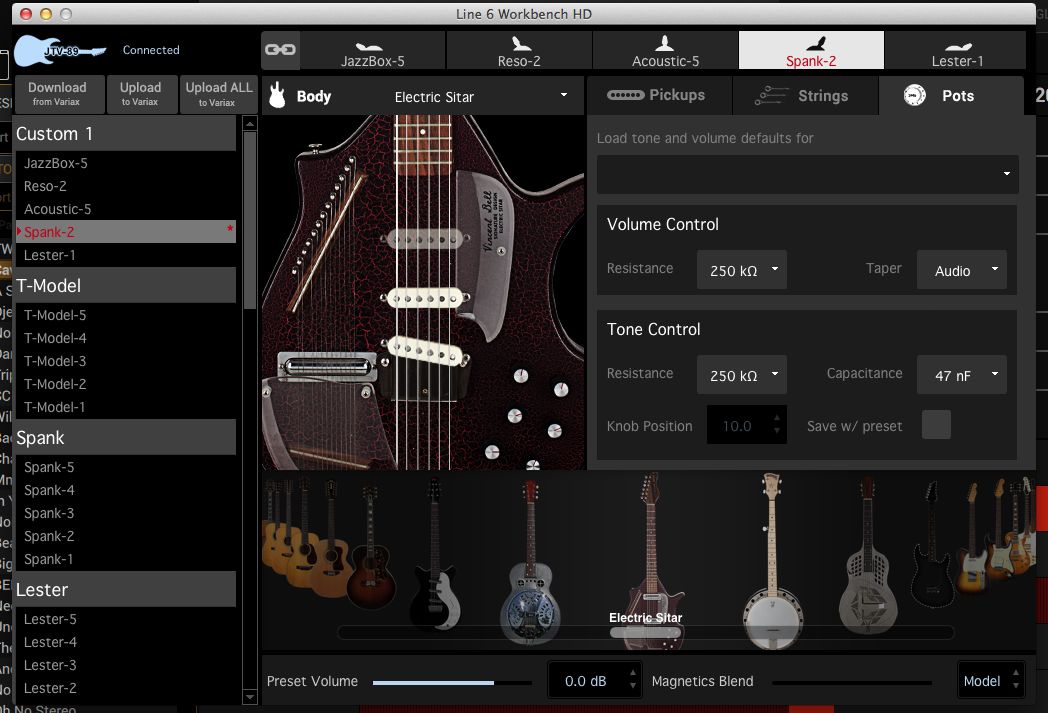
The final page determines the way the volume and tone controls work. Here you can select your own volume and tone pot values, audio (log) or linear taper, and even choose the value of the tone control capacitor. For the non-technical, the larger the capacitor value, the more effect the tone control has.
Why Don't They...?
Just a few minutes using Variax Workbench proves that there are some very worthwhile hybrid combinations of bodies and pickups to be had, but if I put on my 'Why don't they do this?' hat, I can always think of things to add. For example, the graphics do not including positional dimensions for the pickups (though there is a readout of pickup angle), and guitar designers would surely find this a very useful research tool. Furthermore, while there are plenty of body types from which to choose, you don't get to choose maple or rosewood fingerboards, and in my experience, the choice of neck often has a significant influence on the character of the guitar sound, especially with Strats and Teles. Perhaps giving the user one body model of each neck type for the most important instruments would be the way to deal with this? I've also found that differences between the various models of actual Variax guitars, particularly those with different fingerboard woods, result in a slightly different tonality, so maybe some way to compensate for the particular guitar model you're using would also be useful.
Within Workbench, you can't set whether the body has a tremolo or not, and the resonance of the springs has some bearing on the sound — indeed, Line 6 model this factor on the 'Spank' model, which is obviously based on Fender's classic Stratocaster, and damp the springs in the tremolo-equipped Variaxes (at least in the Variax 600 I used for these tests) to prevent them colouring the non-tremolo models. It could be interesting to deliberately add these spring resonances to guitars that don't normally have tremolos. There's no option to fit pickups to the acoustic guitars; this is understandable, as the acoustic models are based on the miked-up sound of the instrument, but there are times when it's nice to mix the miked sound with that of a single-coil magnetic pickup. I'm not sure whether this is a philosophical limitation or whether there simply isn't enough processing to do acoustic mic modelling and pickup modelling at the same time. And before I stop myself saying 'and another thing', perhaps it would make sense for future versions of the software to also emulate string gauge, as that affects the tone significantly. If you could tell the software what strings you actually had fitted and which ones you'd like to sound like, it could be a real benefit and I'm sure the technical gurus back at Line 6 HQ could figure out how to do it in their lunch break!
Getting To Work
As a means of reconfiguring what the Variax already offers, Variax Workbench has the benefit of being both simple and powerful, with some very nice graphics to put the user at their ease. The ability to store libraries of custom sounds is to be welcomed and best of all is that the software is essentially free — you only pay for the USB interface if you don't have a Vetta II or PodXT Live to hook up your Variax to your computer. Being able to twang away on the guitar as you shuffle the pickups and bodies also makes the customisation process very immediate and it is educational to see what a big difference a small change in pickup position can make. The bottom line is that if you have a Variax and you have a computer, then you owe it to yourself to get Variax Workbench. Of course you can always think of more things you'd like to have added to the capabilities of the software (such as pickup magnet age and height adjustment), but what you get is a good compromise between flexibility and user-friendliness, with a great graphical interface.
Alternatives
Router, bandsaw, soldering iron, box of pickups...
Parts List
Body Models
- T-Model Custom
- T-Model
- T-Model F Hole
- Spank
- Lester Flametop
- Lester Custom Goldtop
- Lester Custom
- Special Junior
- Special Special
- Special FB
- R-Billy G-Brand
- R-Billy Sparkletop
- Chime FullCircle
- Chime FullCircle-12
- Semi Blues
- Semi Pokerface
- Jazz Seventy Five
- Jazz Super Four
- Acoustic Dreadtop
- Acoustic Dreadtop-12
- Acoustic Parlor
- Acoustic Jumbo-12
- Acoustic Jumbo
- Resonator Biscuit Bridge
- Electric Sitar
- Masonite Plank
- Lester's Banjo
- Tricone Resonator
Pickup Models
- T-Model Bridge
- T-Model Neck
- Spank Single Coil
- Lester Neck
- Lester Bridge
- Semi Humbucker Neck
- Semi Humbucker Bridge
- Jazz Neck
- Jazz Bridge
- Special 90
- Junior 90
- Special Mini
- Semi 90
- R-billy Tron
- R-billy Sonic
- Chime Toaster
- Reso Lipgloss
Pros
- Free or inexpensive depending on what other Line 6 devices you own.
- Very easy to use.
- Allows you to build almost any guitar you can imagine.
Cons
- No obvious cons, but as with any useful software, you can always think or more things you'd like to add.
Summary
If you have a Variax, this software enables you to create custom shop guitars on your own computer and play them while you're tweaking. It doesn't get much easier than this.
information
£84 including VAT.
Line 6 Europe +44 (0)1327 302700.
+44 (0)1327 302702.
We get up to speed with the latest leaps in Line 6’s guitar‑modelling technology.
The Line 6 Variax has evolved considerably since the first models appeared. They sported no conventional magnetic pickups at all but instead had a set of six piezo pickups set into the bridge saddles. These picked up the signals from the individual strings and the guitar then converted them to a digital signal before processing them via the onboard DSP modelling engine. The same hexaphonic pickup system is still used today, but for the past few years the modelling technology has been put to work alongside the conventional magnetic guitar pickups. This has given the user the ability to switch between the ‘normal’ and Variax modelled sounds, and also to provide a safety net should the Variax battery ever go flat during a performance.
Since Line 6 were acquired by Yamaha, the Variax technology has been teamed with Yamaha‑built guitars, and this current generation uses a more detailed modelling process that has been made possible by increases in the DSP power that runs the HD v2.0 firmware. To take advantage of this power, the Line 6 engineers used the best‑sounding guitars from a very valuable collection as the benchmarks for their models. The basic formula, however, is pretty much the same as before for the majority of the guitars being modelled (see box).
There are now several different guitar models in the current Variax range, including two Shuriken models and three James Tyler models (often referred to as ‘JTV’), one of which is a dual‑humbucker, single‑cutaway design. In this review we are looking at the least costly Variax Standard — the specific model sent for review being the Variax Standard Limited Edition Onyx, the latter parts of the name referring to the finish on the body.
Banks & Tuning
A push/pull dial switches between regular and modelled guitars, and accesses one of 10 preset model banks plus two further user‑definable custom model banks. The user banks can be set up using the free Workbench HD software, which connects to the guitar via a dedicated USB interface. You can also just copy your favourite factory presets into the banks for ease of access, if you wish. The 10 switch positions are called banks because the five‑way pickup selector switch on the guitar accesses five different presets within the bank, usually (but not for the Acoustic and Reso models) corresponding to different pickups and/or combinations.
As with previous Variax models, the model selection is via conventional looking knurled knobs on the guitar — though now there are more and better models on offer.In Variax mode the Guitar Model Select knob LED illuminates to show the active guitar model. We’re told that the output levels of the modelled sounds have been matched to the original instruments, so a humbucker model may sound louder than a single‑coil model. As with earlier Variaxes, the guitar’s Tone control adjusts the virtual mic position rather than EQ for the acoustic models. Note, though, that the Workbench software allows you to mix in some of the sound of the guitar’s magnetic pickups with the modelled guitar sounds.
A second knob selects from 10 pre‑loaded alternative tunings, but these can be changed using the Workbench software if you need something less common. The models and tunings can be used in any permutation. The Standard setting leaves your guitar tuning alone — in other words, it follows the way you’ve physically tuned the strings — but the pre‑loaded Alt tunings assume you’re using standard guitar tuning. The Model position uses whatever tuning is stored in the selected preset. And if you don’t use standard tuning or want something that’s not on offer, you can construct your own set of Alt tunings, again using the Workbench software.
The Guitar
The Variax standard is a three single‑coil pickup guitar with a vibrato bridge, and it shares its DNA with Yamaha’s Pacifica— which in turn tips a wink towards Leo Fender’s finest. This example has a bolt‑on, 22‑fret maple neck with a dark‑wood (known as Macassar ebony) 13.78‑inch radius fingerboard. The 25.5‑inch scale neck has a palm‑friendly medium profile, though I thought perhaps the fingerboard edges could have been rounded a touch, to make the guitar feel that little bit more comfortable. There’s a forearm chamfer but no belly cut on the rear of the alder body, which makes this guitar a little heavier than a typical Strat.
Our review model was set up well right out of the box and once the strings were stretched in, the tuning was pretty stable, aided perhaps by the black, self‑lubricating Tusq Graphtech nut. The three single‑coil Alnico V pickups are described as ‘vintage voiced’, and the piezo saddles are from LR Baggs. In ‘normal’ guitar mode, the pickup switch works as it would on any Strat‑type guitar, accessing individual pickups or either of the outer pickups combined with the middle pickup.
Unlike a Strat, there’s just a volume control and a single tone control (in contrast with the Fender Strat’s dual tone controls), and in modelling mode the volume pot taper is arranged to behave as on the modelled instrument. If you fancy a solderless rewire, you can change the pot and capacitor values in the Workbench software, as well as wiring pickup pairs in series or parallel.
Overall, the standard of finish and engineering is all that you’d expect from Yamaha, though it’s worth mentioning that the vibrato would benefit from a spring in the arm cavity, since the threaded arm feels quite loose until you reach the end of the thread.
By way of connectivity, there’s a standard quarter‑inch jack to connect to your amplifier, and a second port that takes a network‑style cable that connects to the included USB interface. Power comes from a lithium camera‑style battery that fits into a compartment on the back of the guitar, and a charger is included. A fully charged battery gives around 12 hours of operation. However, you can also supply power to the Variax without a battery if it is connected to VDI Digital Input equipped hardware, such as the Pod HD500X or Helix, or a JTV Cabled Power Kit. You can’t, however, charge the battery or power the guitar via USB. We’re told that the HD Variax range can be paired with the Line 6 Helix, Pod HD and Firehawk families for the saving of combined guitar/effects presets. There’s also limited compatibility with Pod XT, Pod X3, the Vetta II amplifier and some other legacy Line 6 products.
Both the body and headstock of the Onyx model usually appear almost black, but from certain angles and in the right light, the decorative pattern is revealed.In addition to the expected models inspired by Fender’s Strat and Telecaster, Gibson’s Les Paul, Special, Firebird, Super 400 and 335, there are semi‑acoustic rockabilly models based on Gretches, emulations of both six‑ and 12‑string Rickenbackers, a Danelectro and a smattering of acoustics, again with 12‑string options. There’s also a banjo, a resonator guitar and an electric sitar, where the tone control adjusts the level of the sympathetic strings. Some users have wondered why a ’Strat‑alike’ guitar needs a Strat model, and there are actually two reasons: firstly the model is hum‑free and secondly, you can use the alternate tunings with it.
Without using the Workbench HD software, you can store any of your favourite sounds into the user locations along with an Alt tuning if you need one. However, the Workbench HD software is very easy to use and lets you do things like change pickup type, position and angle as well as customise tunings and component values. If you fancy hearing a Les Paul body with two Strat pickups and a Gretsch ‘toaster’, you can build your own right here, and save it as one of your custom sounds. You can also replace any of the original Alt tunings, other than Model and Standard, as well as mixing in some of the magnetic pickups — which only makes sense on patches with standard tuning of course. The factory Alt tunings include drop D, down a semitone, down a tone, open G, baritone and DADGAD.
Impressions
Line 6 Workbench Hd Software System Requirements Mac Os
The use of piezo saddle pickups has both good and not‑so‑good aspects. The chief benefit is that they are totally immune to electromagnetic interference, which means the DSP always gets to deal with a clean signal. This is good news in the studio, where you might very well be working very close to equipment that causes conventional guitars to buzz and hum. The down‑side is that they make the bridge slightly microphonic. It’s not usually a problem in practice, though if you’re heavy‑handed on the vibrato arm you may hear some unwelcome noise. While this inevitably remains the case, this new model seems better behaved in this respect than the original Variax models.
Right out of the box, while the guitar itself is decently constructed, it felt a little too ‘new’ for my taste. It would benefit from a bit of playing in, and if it were my own guitar the first thing I’d do is ‘roll’ the fingerboard edges with a scraper. The sound from the new strings was a tad on the bright side, and this also translated to the modelled guitar sounds, but that’s something that would naturally settle down after playing for a few hours. Certainly there was no lack of ringing sustain, and the action was creditably low without choking. Played with the conventional pickups, it comes as no surprise that the guitar sounds very much like a Fender Strat, though having the single overall tone control is quite useful, as it allows the sometimes brash bridge pickup to be tamed.
Switching to the modelled S‑type and comparing with the real thing, the sound is close but not identical. That’s no surprise, though, as the Variax version models a specific instrument that has different pickups and its own unique resonances. The modelled sounds do seem to have a slightly exaggerated attack, possibly due to the response of the piezo pickups, but various forum exchanges suggest that these take only a few hours of playing to bed in fully.
Workbench Hd Software
The other electric guitar models fare pretty well, and though getting a full‑on Les Paul grunt is a bit of an ask, if you’re in a covers band and you need to throw in a ZZ Top number, you can get close. To my ears, the other solid‑body models sound much as they do from my original Variax (which I still have) but with perhaps more in the way of dynamic response and also a little more clarity. As with earlier models, the 12‑string emulations work really well in the context of a band but, like the acoustic emulations, they still don’t really stand up to close solo scrutiny. In fact Line 6 might have missed a trick with the acoustic emulations, by not allowing some of the piezo pickup signal to be mixed in to ‘dilute’ the very aggressive filtering necessary to transform the spectrum of an electric guitar string into that of an acoustic guitar. The semi‑acoustic electric sounds are nicely convincing, while the resonator guitar is excellent. So too is the electric sitar and, in a mix, the banjo also sounds surprisingly authentic.
Given its modest asking price, the Variax Standard has the makings of a good electric guitar, even without its Variax capability — though I feel that not getting a gig bag as standard is perhaps a bit tight. Yes, the guitar would benefit from a little fettling to make it more comfortable, but at heart this is a well‑built guitar made using high‑quality materials.
The Variax capability adds an immense convenience factor — very few of us can turn up at pub gigs or to a studio session with a dozen different guitars — and for the most part (I’m still not sold on the acoustic sounds, especially for recording), the sounds are reasonably convincing. There are plenty of good sounds to be had, all without the hassle of hum and buzz, and with alternate turnings available at the turn of a dial.
Alternatives
Line 6 Workbench Hd
There aren’t really any direct competitors, though the more costly Roland V Guitar — which offers fewer options and no software editability — works well and is built into a US‑made Fender Stratocaster.
Variax Sounds: Then & Now
Regarding the question of how the original and HD modelling systems compare, Line 6 tell me that 18 of the 20 electric guitar models in Variax HD were remodelled versions of the same (or similar) physical guitars from the original Variax generation — and that the HD modelling is, from both a DSP and process perspective, more accurate this time around. There are some very distinct differences, if you’re listening out for them. For instance, the Les Paul pickups are louder, the archtops are more accurate, and the Strat is much more realistic. Line 6 have also, amongst other things, made improvements to the filtering of undesirable sonic artifacts and improvements to the response of the modelling when palm muting.
Summary
Though some users may perceive little difference in sound between the HD and previous Variax models, the partnership with Yamaha has produced a cost-effective guitar that plays well in its own right as well as delivering all the Variax options.
information
Line 6 Workbench Hd Download
$899.